Chainsaw Supervisors – Safety & Operational Compliance
Chainsaw Supervisors – Safety & Operational Compliance develops the knowledge to supervise forestry chainsaw work safely and check operational compliance. Eight modules cover responsibilities, competence, site planning, operator supervision, emergencies, steep ground, environmental protection and team leadership. Build practical evidence through site inspections, briefings, poor-practice reviews and incident scenarios, with a field-day assessment and printable supervisor records. For managers, site supervisors and team leaders overseeing forestry operations.
H&W Training · Forestry supervisor learning
Chainsaw Supervisors – Safety & Operational Compliance
Recognise · Check · Communicate · Act
Plan the work. Recognise unsafe conditions. Check the controls. Stop and escalate when the job changes.
H&W VIDEO LESSON · 1:13 · CAPTIONED
Watch: Welcome: supervise with confidence
Open video separately · Kirk narration. Pause at the decision prompt and explain your answer before continuing.
Use with the detailed lesson and current source guidance; these scenes are not footage of live chainsaw operations.
Chainsaw Supervisors – Safety & Operational Compliance is a forestry-focused supervisor awareness course for managers, site supervisors and team leaders who oversee chainsaw work. It combines the H&W Forestry Works Manager approach with selected Chainsaw Hub learning and practical supervision exercises.
Before work starts: access, PPE and first aid
- Roads, forestry tracks and public paths — permissions, access controls, communication and stop-work decisions.
- PPE requirements — protection, trouser class/design, markings, fit and condition.
- First-aid requirements — forestry training, certificate/refresher dates, kits and effective cover.
Use the supervisor verification checklists and apply the checks in the field-day scenario.
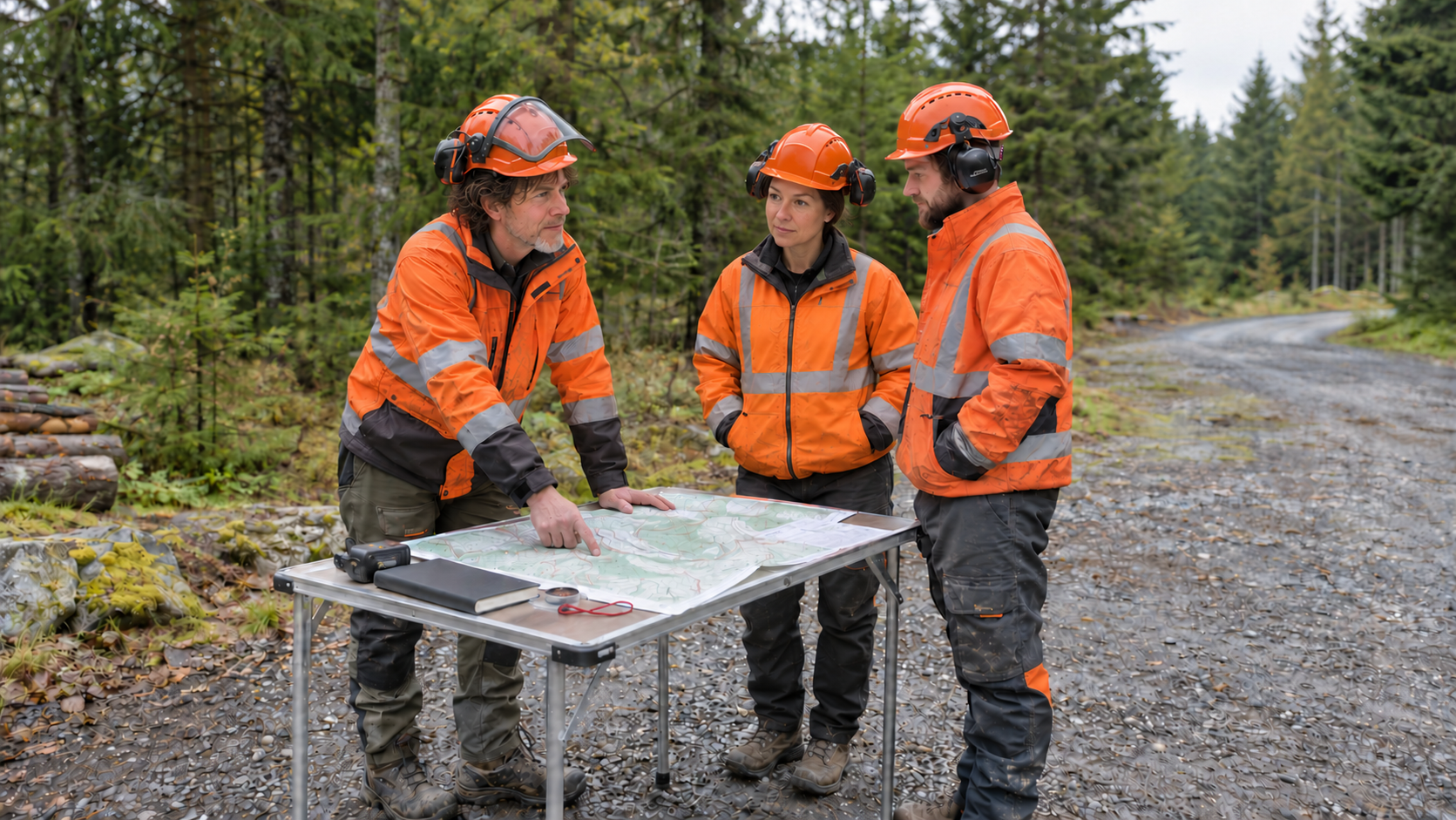
Learn online
Eight modules, short decision checks, forestry images and selected Hub videos. Record your answers and questions for the tutor.
Prepare your evidence
Complete the online activities and prepare your site plan, competence checks and supervision decisions for the field day.
Apply on site
One practical field day with controlled observation, a site inspection, briefing and emergency-planning exercise.
What you will demonstrate
The course develops seven core areas of supervision and adds explicit assessment of complex forestry hazards and follow-through. Each outcome has an identifiable piece of evidence; attendance alone is not evidence of achievement.
| Outcome | By the end of the course you will be able to… | Learning | Assessment evidence |
|---|---|---|---|
| O1 · Role and legal duties | Explain the responsibilities of the relevant forestry roles, apply PUWER checks, recognise when lifting duties need competent review, and distinguish legal duties from guidance. | Modules 1–2 | Responsibility map and legal-duty discussion |
| O2 · Site preparation and safe systems | Review a site plan, identify significant hazards and affected people, specify suitable controls and justify whether work can start. | Modules 3 and 6 | Annotated site plan and pre-start decision |
| O3 · People, equipment and working practice | Match competence evidence to the actual task and recognise suitable equipment, PPE, safety checks and unsafe working arrangements. | Modules 2 and 4 | Competence check and controlled observation |
| O4 · Correcting poor practice | Intervene safely, establish why a control failed, compare practicable alternatives and verify that corrective action works. | Modules 4 and 8 | Intervention discussion and corrective-action record |
| O5 · Environmental responsibility | Identify sensitive receptors and pollution pathways, check site restrictions and permissions, and manage an environmental concern through competent referral. | Modules 3 and 7 | Environmental inspection and incident scenario |
| O6 · Emergencies and incident learning | Check a workable emergency plan, coordinate a scenario response, distinguish reporting routes and explain safe restart requirements. | Modules 5 and 7 | Emergency exercise and incident review |
| O7 · Team planning and communication | Allocate roles and supervision, deliver an understood briefing, address fatigue and test remote/lone-work arrangements and handover. | Module 8 | Team plan, observed briefing and change scenario |
| O8 · Steep ground and complex hazards | Recognise unstable ground, rolling timber, hung-up trees, windblow and root-plate hazards, and refer specialist work without improvising a cutting method. | Module 6 | Changed-conditions decisions |
| O9 · Evidence and follow-through | Produce clear inspection records, assign and verify actions, and document a justified restart or continued hold decision. | Across the course | Completed supervisory evidence file |
Final e-learning exam
Complete 30 multiple-choice questions covering all eight modules. Pass mark: 80% — 24 correct answers out of 30. Feedback appears at the end without revealing the correct answers. Retakes are available after revision.
Your learning route
The five core modules follow the February 2025 H&W scope. Modules 6–8 add steep ground and complex tree hazards, environmental protection and pollution response, and team leadership, fatigue and lone working. Work through the lessons in order, then prepare the field-day evidence.
- Module 1: Chainsaw operations and the supervisor role
- Module 2: Legislation, competence and compliance
- Module 3: Site planning, steep ground and environmental risks
- Module 4: Supervising operators and checking safe systems
- Module 5: Emergency planning and incident management
- Module 6: Steep ground and complex tree hazards
- Module 7: Environmental protection and pollution response
- Module 8: Team leadership, fatigue and lone working
- Field day: Supervision practice and assessment
- Supervisor checklists and assessment record
- FISA chainsaw guides and downloads
- Lantra and NPTC qualification flow charts
- Final e-learning exam — 30 questions, 80% to pass
Your supervisory evidence file
Build a small, useful file as you learn: a responsibility map; a task/competence check; an annotated site and environmental plan; a team briefing; an inspection and corrective-action log; an emergency plan; and a justified restart decision. The field day brings these together in a simulated forestry assignment. Use the checklists and record templates at the end of the course.
Guides and practical reference
FISA chainsaw guides and downloads: seven core chainsaw guides, emergency planning, utilities, inspection and supporting HSE documents. Modules 2–5 include direct downloads and expanded legal, risk-assessment, PPE and equipment checks; Module 8 includes an applied fatigue plan.
Lantra and NPTC qualification flow charts: one Lantra chart and one NPTC chart, with printable PDF downloads. Refresher guidance is in Module 2.
Before attending the field day
Complete the learning checks; bring your notes and a sample site plan or risk assessment if available. Remove personal or commercially sensitive details from examples shared with the group. Confirm the joining instructions, fitness and access needs, suitable clothing and required site PPE with the instructor. You will observe and practise supervision tasks; operating a saw is not part of this awareness course.
Use your existing Hub learning
Forestry Works Manager course: roles, contractor selection, planning, communication and emergency arrangements. Chainsaw Maintenance and Cross Cutting Hub: PPE, safety features, equipment checks and recognition of unsafe operation. Existing enrolment or course access requirements still apply.
H&W Training · Supervisor awareness · Course version 1.5, November 2026. Based on the H&W February 2025 scope, with additional supervisory learning and assessment activities.
Media update, version 1.5: 13 original Kirk-narrated videos with captions across the learning pages, plus two existing Chainsaw Hub videos. Personalised forestry illustrations feature Stephen and Gail in selected scenes.
Log in or create an account to access this course.
Register
New here? Create an account to request access. We will email you when it has been approved.
Have a course password?
If your trainer gave you a password for this course, enter it here.